
Up to 66% of American youth express interest in starting their own business or pursuing entrepreneurship as a career.
*According to Junior Achievement
The Urgent Need for Entrepreneurship Education in American Schools
Entrepreneurship is widely recognized as a critical driver of economic growth, innovation, and social impact, yet formal entrepreneurship education in American schools remains limited. Surveys indicate that between 41 percent and 66 percent of American teens express interest in starting their own business or pursuing entrepreneurship as a career (Junior Achievement). Despite this high interest, access to structured entrepreneurship programs is sparse. While 42 states provide guidelines for entrepreneurship education, fewer schools offer dedicated courses (Junior Achievement). This gap represents a significant missed opportunity to cultivate the next generation of innovators, problem-solvers, and economic leaders.
The Case for Entrepreneurship Education
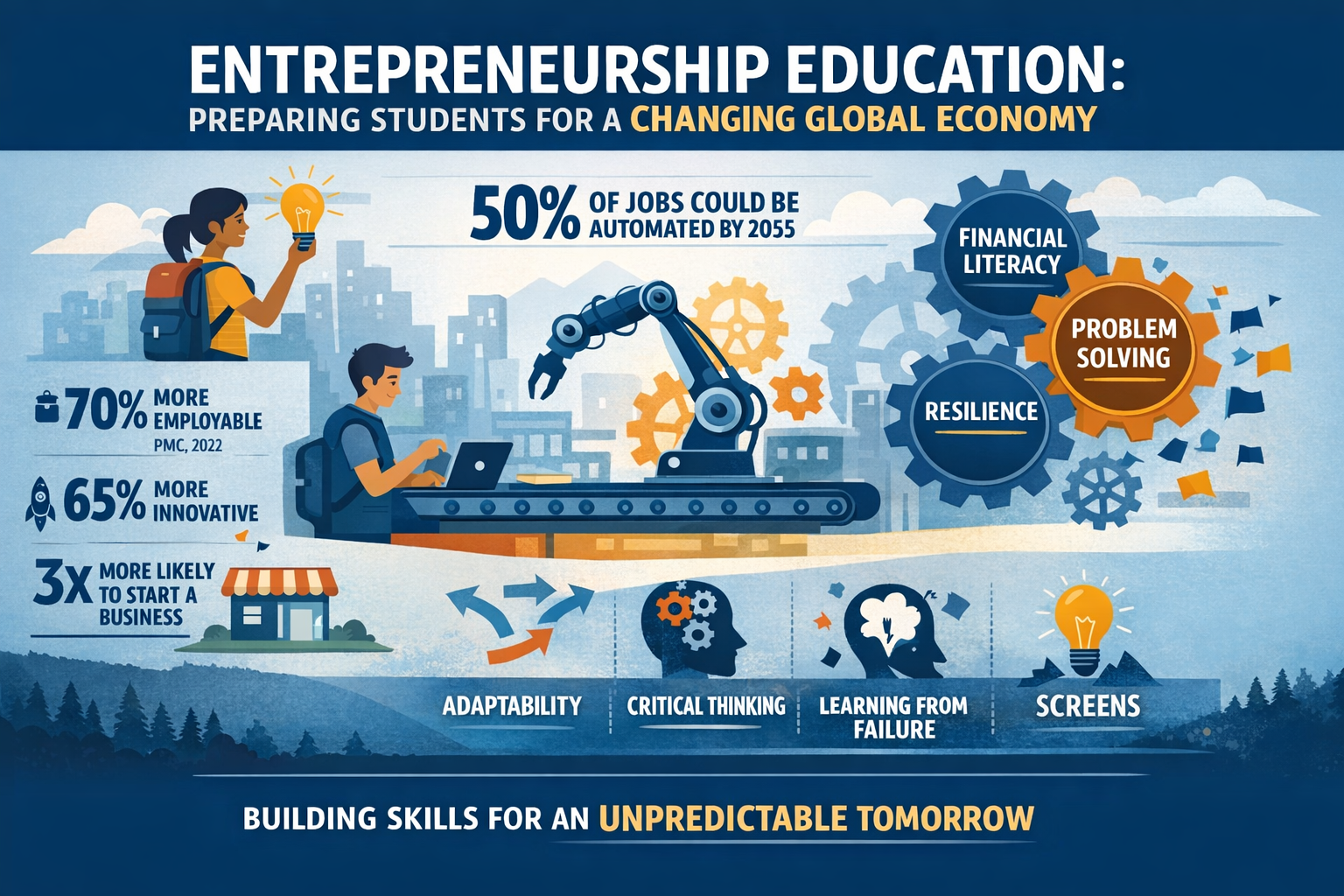
Entrepreneurship education is more than teaching students to start businesses. It prepares them for a rapidly changing global economy. Studies show that entrepreneurship education significantly boosts employability, fosters innovation, and increases entrepreneurial intentions. It equips students with practical skills such as financial literacy, resilience, and strategic problem-solving (PMC, 2022). These skills are essential in a world where the World Economic Forum projects that 50 percent of work activities could be automated by 2055, creating unprecedented uncertainty about future careers. Entrepreneurship education cultivates adaptability, critical thinking, and the ability to learn from failure, skills that conventional curricula often overlook.

Key Benefits of Entrepreneurship Education
Entrepreneurship education prepares students for an uncertain future.
It equips students to navigate complex challenges, from technological disruption to social and environmental crises. Unlike traditional instruction, which often presents pre-defined problems, entrepreneurship programs teach problem identification, empowering students to discover opportunities and unmet needs before seeking solutions.
Entrepreneurship education encourages creativity and collaboration.
Modern schooling’s emphasis on standardized testing has narrowed opportunities for innovation. Entrepreneurship education encourages collaboration, experimentation, and creative thinking, skills prized by top colleges and essential in the modern workplace. Activities such as brainstorming solutions to transform a piece of land into a profitable venture help students see how creativity and teamwork drive tangible results.
Entrepreneurship education develops grit.
Research by Angela Duckworth highlights grit, defined as passion and persistence toward long-term goals, as a stronger predictor of success than intelligence or socioeconomic status. Entrepreneurship programs inherently demand grit as students navigate trial, error, and risk in simulated or real ventures. Hands-on assignments, such as creating a vision tree that maps strategy and actionable steps toward goals, build sustained persistence and self-efficacy.
Entrepreneurship education has an economic and social impact.
Studies indicate that entrepreneurship education is strongly correlated with higher intentions to seek venture capital and increased financial self-efficacy (PMC, 2022). In the United States, small- and medium-sized businesses account for roughly 70 percent of GDP and global jobs. Business equity comprises 20 percent of household wealth, and 90 percent of new billionaires are self-made entrepreneurs. Entrepreneurship education also has a disproportionate positive effect on women and underrepresented students, helping to reduce the gender gap in entrepreneurship.
References
Junior Achievement. Entrepreneurship Interest Among American Teens.
PMC. 2022. Entrepreneurship Education: Impact on Intention, Employability, and Wealth. https://pmc.ncbi.nlm.nih.gov/articles/PMC9723218/
Duckworth, A. 2016. Grit: The Power of Passion and Perseverance.
World Economic Forum. Future of Jobs Survey 2020.